Archive for the ‘Punjab’ Category

The article in Punjab Today condemning Shekhar Gupta’s lies has evinced greater interest in the Diaspora. Recently Punjabi Radio USA interviewed me and we discussed how media mis-represents Panjab. In fact, even more than that how Panjab has been steadily mis-represented. Thank you Harvinder, Gurjaspal, and Arvinder. Chardi Kala.

Please listen here … 


Canadian Prime Minister had barely finished a successful meeting with Panjab Chief Minister when another controversy erupted: a past offender Jaspal Atwal showed up at Trudeau’s dinner previous, his pictures with Sophie Trudeau and Amarjit Sohi splashed in newspapers. He had a dinner invite to the Canadian High Commission. Canada rescinded the invite.

This is why it is so hard to arrive any simplistic, black and white understanding of Panjab, Sikhs, Khalistan. As I said in the earlier interview – Panjab remains a landmine. By themselves the pictures are not conclusive, but the questions are:

a) How did Atwal land a dinner invite with Trudeau?

b) How did the Indian government allow Atwal entry?

Could this controversy have been avoided? YES. YES. YES. Especially at such a sensitive time, by all parties: Atwal himself by not coming, not going around getting photographed, MP Sarai by not recommending Atwal, Canadian High Commission by doing due diligence, Canadian PMO by not inviting Atwal. Now, of course, they have rescinded the invitation. Again, too little, too late. I do believe that after conviction, imprisonment, and release people should be allowed to merge with society with dignity. After all, we must not be prisoners of our past. But that is the razor’s edge of liberal politics: has Atwal adequately distanced himself from Khalistan? Has Atwal committed himself to peace? I do not know.

However, through all this I noticed one man, former Liberal and Premier of British Columbia Ujjal Dosanjh, play a role on social media: he was blaming Khalistan, Trudeau and over-liberal politics. I have a few questions for him.

Punjab Today impact: the recent Punjab Today article calling out the Indian media’s half-baked truths which were set to jeopardise the meetings between Punjab CM and Canadian Prime Minister elicited interest of the Ferndale, Washington based KRPI Radio 1550 AM.

Harjit Singh Gill talks to Amandeep Sandhu. It is 32.57 minutes. It is in Punjabi. Please listen here …

Thank you Punjab To for picking my morning post on how sadly the Shekhar Gupta run The Print and even other Indian media channels seek to discredit duly elected members of the Canadian Parliament upon their visit to India.

Sadly, much of media reports complex situations – especially when it comes to Panjab, Sikhs, Khalistan – in a black and white manner. With an overdrive of Indian nationalism. It hasn’t helped anyone and even after a quarter century of guns going silent Panjab remains trapped in this question of Khalistan. My fear is an old one – the half-baked truths lead to rhetoric, jingoism, suspicion, antagonism which keep Panjab entangled and hamper our search for ways to heal.

Please read here …

Friends, I wrote this post a few days back and dear Kanwar Manjit who runs Punjab Today picked it up. Perhaps I am very late to say this about AAP but I came to the understanding only recently. You all know I am slow.

Please read here …

Friends, more than a year back, an artist came home to discuss Panjab. Especially the years of militancy. He was studying in the Netherlands and was conceptualising a project related to his early memories of the reign of terror (1978-1993). We spoke a lot including about how his uncle was picked up by militants for ransom and how a dear friend of mine’s sister is named after his aunt. Since then he has remained in touch. Just that we could not meet. Even when I was in Europe this year or when he was in Delhi a few weeks back and had performed at JNU.

Yesterday, Vinutha Mallya, now a journalist from Pune contacted me to discuss those years. She said it was for a piece they were writing on the work of a young artist. I asked if the artist was Abhishek Thapar. She said yes and I was happy to support him.

‘My Home is at the Intersection’ opens at TIFA Working Studios, Sadhu Vaswani Circle, Pune on December 22 – 23, 7 pm. CALL: 9623444433.

Pune friends, please attend, please spread the word.

The piece is below. I find it heartening that a new generation is taking interest in Panjab and pushing it beyond what has been our defence and safety net for decades: mitti pa, sannu ki – bury it, what is it to me?

It is not that Panjab does not want to tell its stories, it is that Panjab’s stories are too overwhelming to be told. Every effort counts. Must say it is the same with the world at large. It really has to be nudged to listen. Panjab remains a shadow area tied up in the larger perception that these are just Balle Balle happy go lucky people.

Please read here …

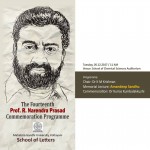
Friends, this Tuesday I was humbled to speak at the annual Prof. R Narendra Prasad memorial lecture at the School of Letters, MG University, Kottayam, Kerala. Thank you Saji Mathew for the invitation. In keeping with Prasad Sir’s lifetime work in theatre and films, I named my talk: Panjab – a tragic hero on the stage of Indian nationalism.

The talk was covered in local newspapers.

Friends, I put up a Facebook post on the right wing move to rename the Sardar Dyal Singh Majithia college in Delhi. A news and views website I refer to often, run by Kanwar Manjit Singh, decided to choose it for the website.

Thank you. Please see here…


Friends, my first article in Tamil.

A few weeks back The Hindu (Tamil) called me asking for an article on the DMK leader M Karunanidhi. I replied I was most poorly placed to talk about him. They persisted saying it was for their commemorative issue. I sat down to write and realized the deep solidarity between Tamil and Punjab politics in opposition to the central government. Issues include language and call for greater federalism. I am sure the translation does justice.

Federalism and the Delhi Durbar

What Europe did in terms of political reorganization in 1993, India had already done in 1947. The European Union was a coming together of nations to form a unified market, after independence India came together as a union of states bringing together many distinct and diverse nationalities in terms of the people’s ethnicity, languages, culture, customs, traditions, cuisine, costumes and aspirations. A quarter century after the formation of the European Union, the cracks that now show up in Europe’s composite narrative – of inequality between nation states – have been far too visible right from the inception of the modern Indian state. All these wounds in India erupted from a single call: greater federalism, enshrined in the Indian constitution, which challenges the centre’s push to impose a uniform framework on the nation – mostly in terms of language, taxation and governance.

Punjab is a case in point. Post-independence the centre reorganised the rest of the country on linguistic lines by creating the states but denied the same status to Punjab. It feared a Sikh religion majority state next to Pakistan already carved out on religious lines. The States Reorganisation Commission report in 1955 did not consider Punjabi language unique enough to ask for statehood and sought to impose Hindi on the region. This led to a decade long non-violent Punjabi Suba agitation led by the Akali Dal in which thousands courted arrest. Finally, in 1966, Punjab was trifurcated into a territorially much diminished state. But Punjab had learnt well the shenanigans of the Delhi Durbar. The Akali Dal sought to re-look the centre-state relationship and articulated their stance in the Anandpur Sahib Resolution, 1973.

The Resolution sought greater powers to the state over the headworks of its rivers, stake on the capital Chandigarh and Punjabi speaking areas left out of the state. It questioned the centre not allowing the state to benefit from the tax structure of the Green Revolution ushered in the state a decade back to save India from hunger. It sought an end to exploitation of cash crops, raised the need for crop diversification, tax subsidies on farm machinery, pushed for government procurement of all farm produce, and rapid growth of the agro industry. It sought a dry port to trade with neighbouring countries. It also called for reinstating the dignity of Punjabi language and a radio station to broadcast Gurbani – the Sikh religious texts.

A similar demand was arising from another set of independent people: Tamil Nadu. The Dravida Munnetra Kazhagam, owed its birth to the Dravidian anti-Hindi movement against the imposition of the language in the 1940s/50s. In 1971, the Rajamannar Committee – instituted under the leadership of Karunanidhi of the DMK – presented its resolutions suggesting the formation of an inter-state council to suggest changes to the relationship between the centre and the states and secure greater autonomy for the states. Former Chief Justice of Madras, Dr P.V. Rajamannar sought reconsideration of Articles 256 and 257 (Obligation and Control of States and the Union) that empower the central executive to issue directions to the state governments and to reorganize the items in the Union, State and Concurrent Lists. He called for a re-look at the Planning Commission, the repeal of the Industries (Development and Regulation) Act of 1951, and changing the tax structure.

The centre’s response to both Punjab and Tamil Nadu was extremely slow and finally negative. In the 1980s, it instituted the Sarkaria Commission to look into the calls of the states. The Commission report in 1987 ignored the core demands but proposed other Constitutional measures. The centre ignored it, locked it away. Recently, in an effort to make India a single market regime through the Goods and Service Tax, the government bandied a new term Cooperative Federalism which is an inherent oxymoron. What does it even mean? The sub-text is clear: the Delhi Durbar lacks the political will to give up its control of the states.

The tension shows up in the revival of Hindi language politics, in the inter-state water distribution whether it is the Sutlej Yamuna Link Canal or the Cauvery Water issue, the agrarian and industrial crises and farmer and labour suicides. The struggle for federalism is more than a half century old and Badal and Karunanidhi have turned nonagenarians. But the Delhi Durbar – in spite of change of guard – has grown stronger at the cost of the states. The wounds on India’s body politic remain unaddressed. Some have dried into scars but all remain alive and continue to fester. They will not heal until the centre yields.

Also posted here …
Friends, my review of the two volumes on the Anglo-Sikh Wars by Amarpal Singh Sidhu. Thank you Arunava Sinha for the opportunity.

‘Singh, a self-trained historian probes the one liner every Sikh child grows up learning: our armies were great but our leaders betrayed us. The volumes are a revelation at many levels, but primarily in seeing how they mark the author’s growth as a historian – right from his sense of purpose, content, style, facts and presentation.’

Please find here …