Preeti Singh read and reviewed Roll of Honour. Then she interviewed Daljit Ami, the translator, and me for her article on the book and the process of translation. I wish more such pieces are written on the efforts of translations between languages worldwide, all books.
Read on …
For a long time now Prof. Rajesh Sharma of Punjabi University has remained supportive of my efforts to write about Punjab. When Roll of Honour was translated into Punjabi Gwah de Fana hon to Pehlan he invited the translator Daljit Ami and me to a joint reading at the university. Since the VC Jaspal Singh had already heard me speak at the university in February this year, he kindly consented to grace the occasion. The Guru Granth Sahib studies department lend us their beautiful horseshoe shaped well lit and airy hall.
The reading was a jugalbandi between Daljit and me. Each of us read out same sections of the book to give students a flavour of how the text feels in the two languages. We also commented on our work and on how we worked together. Prof Jaspal Singh was moved enough to present his experience of the anti-Sikh riots in Delhi of which he had been a victim.
Here is Rajesh Sharma’s account of the presentation in which he appreciates the novelty of our approach and raises further questions on the phenomenon of translations. I am humbled. Please read …
For many years now Punjab has both attracted and perturbed me. As a novelist writing in English on Punjab I have wondered why does Punjab remain lukewarm to my attempts at writing about it. It has taken a long time for me to recognize and grapple with the language divide which exists in Punjab.
Punjab remains lukewarm to the attempts of the English media to narrate its multiple realities. So, while the translation of ‘Roll of Honour’ was much reported about recently in all major English newspapers, assi Punjabi tan udo hi bolange jado kitab Punjabi wich aaugi. (We Punjabis will respond only when the book comes in Punjabi). That has been the unheard comment I have discerned. For that and to connect with the land we decided to translate the book into Punjabi.
Just before leaving Chandigarh on November 6th, to my satisfaction, I saw a four column coverage of ‘Gwah de Fana hon to Pehlan’ in the Punjabi Tribune. With foto and all ji. In picture are the Vice Chancellor Punjabi University Jaspal Singh, Head of English Department Rajeh Sharma, head of Guru Granth Sahib studies.
Please read …
Let the dialogue begin!
The Punjabi translation of ‘Roll of Honour’ by Daljit Ami is now available online. It is reaching book shops across Punjab by the weekend and other e-commerce sites by early next week.
The Punjabi title is spelt as ‘Gwah De Fanah Hon Ton Pahilan’. The publisher is Lokgeet Prakashan/Unistar Books.
Please buy. Please gift. Please bless!
Link here …
Kulpreet Yadav is an ex-Army man. He writes and promotes new talent through his magazine Open Road Review.
He liked Roll of Honour and sought to pursue the genesis of the book to the location in which it is based – Sainik School Kapurthala. Having visited the school, he wrote to me asking why I hadn’t visited the school after passing out from there in 1990. That and Lakshmi’s desire to witness/acknowledge the site led me to school last week.
This interview was done a few days before the visit but talks about how I was already making peace with the idea. Thank you Kulpreet.
Please read …
In this country, where societies have crumbled, systems have eroded, ideologies have been bartered, I still believe in individuals who have risen above sectarianism to uphold what is the idea of a nation.
Of everything I have heard about Roll of Honour, one of the most precious is this by Nandita Haksar, the human rights lawyer. Though I met her only recently she has been my hero for decades.
Read the piece, one of the finest testimonial account of the 1984 violence. Here …
Aparna Banerji is based in Jalandhar. When we went there to participate in the Gadri Babeian da Mela, she caught up with Daljit Ami. It was covered the next day in The Tribune. Aparna is a second generation Punjabi. She was born in Jalandhar, speaks the language fluently, and example of what it means to find assimilation.
Please read …
Gwah de Fana hon to Pehlan was released by Rahul Singh, Rajesh Sharma, and Rajeev Kumar at the Chandigarh Literature Festival on October 31. The release marked the 30th anniversary of Mrs Gandhi’s assassination and seeks to bridge the gap between English and Punjabi, how the previous generation views the anti-Sikh pogrom and how the next generation is dealing with it. Ms Nirupama Dutt also put the book to discussion with Daljit Ami and me.
Hindustan Times covered the event. Please read here …
It is with great pleasure I wish to let you know that ‘Roll of Honour’ has found home in Punjabi. The book is truly grateful to have Daljit Ami as our translator. I have had the honour of working with him through the translation. We are thankful to Harish Jain of Lokgeet Prakashan to have agreed to publish the book. Thanks are due to Rupa Publications.
The cover picture we used is the one which hung in my study as I wrote the book. It is by Sarika Gulati. The cover design is by Natasha Taraporevala.
The Punjabi text ‘Gwah de Fana hon to Pehlan’ will be released on October 31, 2014 at 10 AM at the Chandigarh Club. This event is part of the Chandigarh Literature Festival. After the release well-known author and critic Nirupama Dutt will be in discussion with Daljit Ami and me.
Here is the cover. We seek your blessings.
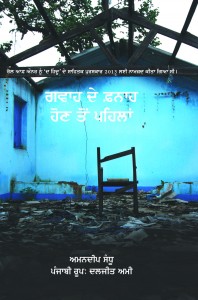
Punjabi Book Cover
Thanks to Margerie from Ireland for chasing me to to this interview. It has come out well.
‘I battled my own self for the longest period, even went through clinical depression for a few months. There are issues like masculinity, sodomy, gay sex, my own views on the events of 1984, the code of honour among schoolmates, communal violence and so on. All of them troubled me when I wanted to write about them. I felt I will earn enemies. It is best to stay silent rather than invite criticism. But I could not sleep. I felt I was cheating by not writing. This is my truth of communal violence and of public schooling in our country. I needed to write it, put it out, to gain some semblance of equanimity in my life. I am very thankful the people have accepted my truths. The book has been lauded, nominated for awards; I have earned a good scholarship from it. The acceptance is a validation of my effort. I feel, in our world, we have space for truth. Let us work to bringing out those truths.’
Read more here …
