The Punjabi translation of ‘Roll of Honour’ by Daljit Ami is now available online. It is reaching book shops across Punjab by the weekend and other e-commerce sites by early next week.
The Punjabi title is spelt as ‘Gwah De Fanah Hon Ton Pahilan’. The publisher is Lokgeet Prakashan/Unistar Books.
Please buy. Please gift. Please bless!
Link here …
Aparna Banerji is based in Jalandhar. When we went there to participate in the Gadri Babeian da Mela, she caught up with Daljit Ami. It was covered the next day in The Tribune. Aparna is a second generation Punjabi. She was born in Jalandhar, speaks the language fluently, and example of what it means to find assimilation.
Please read …
Gwah de Fana hon to Pehlan was released by Rahul Singh, Rajesh Sharma, and Rajeev Kumar at the Chandigarh Literature Festival on October 31. The release marked the 30th anniversary of Mrs Gandhi’s assassination and seeks to bridge the gap between English and Punjabi, how the previous generation views the anti-Sikh pogrom and how the next generation is dealing with it. Ms Nirupama Dutt also put the book to discussion with Daljit Ami and me.
Hindustan Times covered the event. Please read here …
It is with great pleasure I wish to let you know that ‘Roll of Honour’ has found home in Punjabi. The book is truly grateful to have Daljit Ami as our translator. I have had the honour of working with him through the translation. We are thankful to Harish Jain of Lokgeet Prakashan to have agreed to publish the book. Thanks are due to Rupa Publications.
The cover picture we used is the one which hung in my study as I wrote the book. It is by Sarika Gulati. The cover design is by Natasha Taraporevala.
The Punjabi text ‘Gwah de Fana hon to Pehlan’ will be released on October 31, 2014 at 10 AM at the Chandigarh Club. This event is part of the Chandigarh Literature Festival. After the release well-known author and critic Nirupama Dutt will be in discussion with Daljit Ami and me.
Here is the cover. We seek your blessings.
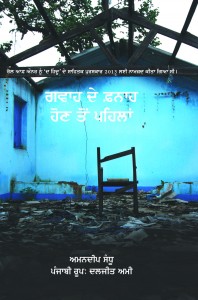
Punjabi Book Cover
Today is Obama’s swearing in. I am eagerly looking at the clock to when the ceremony will begin. Browsing news sites for the exact time of his address I stumbled upon Barack Obama’s Democratic National Convention address in 2004. It tied in with a question I had in mind when I listened to Jayant Kaikini’s talk at his poetry launch in December, 2008. That day the World Cultural Centre in Bangalore was packed with lovers of his writing. Jayant talked of how his songs in Mungaru Male, Milana and other movies had struck a chord with those people who are being increasingly left out of Bangalore’s progress. The cab drivers, the workers of the city who did not get 80 percent marks and who could not get BPO and call centre salaries now felt proud to walk into PVR and see a movie in their own language.
I recognised Jayant’s point about pride for native language and wanted to ask him what should someone like me do? I write but I do not think I belong to a language. Will I ever have a hall full of people on my book launch? I remembered Jayant’s hard days and was happy for this proud moment. But, I wondered if I will ever have people in my audiences who would share the sensibilities of the crowds Jayant had attracted.
I posed the question to Smita Kaikini, Jayant’s wife. She replied: My mother studied in a convent in Goa when the Portuguese were in power there. My mother had struggled for Goa’s independence. She was firm that she will educate her children in the vernacular medium. Our mother tongue is Konkani but Konkani does not have its own script. Marathi is closest and since we were in Bombay, she put all of us in a Marathi medium school.
She further said: Having studied in a Marathi medium school, I had a complex about my English. I did not want it to happen with my kids. So when it came to putting my children to school, I was not ready to put my kids in a vernacular medium school. When my kids sang English rhymes, I knew they did not understand them as we do not speak English at home. I had to explain the meaning of each word (if the rhymes were in the mother tongue they would have been understood without effort). I was uncomfortable, but I did not want my kids to fall behind just because they were not educated in English. If that is the case, what will be the status of regional languages in some years?
This is so right. Maybe I was harking back to an earlier time when people were known by their languages and writers were embodiments of those who had harnessed the language and pushed its envelope to find new meanings. I am sure we will always have language enthusiasts but the reality of more people in the future will be that they will be bi- or multi-lingual. My generation and the next generations will be of those who will struggle with rhymes they do not understand but have to learn and with languages they love but can not use in the bigger world. Maybe writers should, going forward, define meanings irrespective of languages.
Barack Obama’s convention speech is the epitome of such a mixed future. Guess what will remain important is not a language or a regional identity but values. Writing will be about right and wrong, good and bad choices. It will not be about who we are but about what we think and believe in.
Now this might be an absolute extrapolation but it is nagging me and this is my own blog so at the risk of being beaten by you, or you never returning to my site, allow me to suggest something:
I think the very structure of a sentence in English vs. other Indian languages suggests that English is an open language, and it assumes the possibility to step between major agents in a sentence and make the action clear, while Indian languages assume that something will always remain private between two people and the maximum they can do is surround the people but not get in between them to reveal some fundamental truth.
I do not even know if this is a correct extrapolation but I am thinking does this give a cue to the very ways in which the Western and Eastern societies and philosophies are arranged? Rationalism vs. what is badly called Orientalism. It can go on and on … but the essential question remains: did Panini and co actually figure this out?
That language will always explore silences? And language will never be able to replace silences. Swalpa profound 
I see writing as an effort to make sense. Making sense, is, for me, the most fundamental human occupation because unless we know what is happening we do not know what to do. To figure out what is happening between languages while I am translating Sepia Leaves into Punjabi, I noticed something very small and maybe even inconspicuous.
In English, if you give someone something, you say: A gave something to B. The sense I get from this sentence is that A is standing here and B is standing there, and there is a distance between them, and an object to be given, and the language (English) is filling that distance. The whole sentence falls between A and B.
In Punjabi, or Hindi, or Oriya, if you give something, you say: A to B give something. Here A and B are together and the sentence falls outside where they are standing. Wonder if that makes sense? To me it does…
What does it tell us about the differences between Indian languages and English, and the way the two kinds of languages are put together? More examples:
E: A wants to go to the market.
I: A market wants to go.
E: A loves B.
I: A B loves do.
The more I think about it, the more differences I see building out of this simple grammatical structure. Let me explore more or extrapolate more and I will keep returning. In the meantime if you think of something please tell me. I mean I know no body really reads all this stuff
Oh! I wish you, my reader, knew Punjabi. I would have given you examples. But let me try to abstract:
When I started writing Sepia Leaves in English I realised that the dialogue did not come out anything like I could recognise as real. I worked on it and learnt from other writings that a conversation in a work of fiction does not have to be real. It should create reality. I try to do that in my writing. But now that I am translating Sepia Leaves into Punjabi I am surprised at how when I am writing a scene I can almost see it in my mind’s eye. Earlier too I could see it, but it was silent. I had to give it words. Now I see it in dolby sound.
At the same time, since the dialogue in Punjabi comes from the English version and is filtered through my understanding of how it should create reality I am almost achieveing both: reality and creating reality. It is a sense, a sense that what I am doing works for the translation. But it is also a satisfaction that I am getting it accurately.
I learnt Punjabi very late in life. Almost when I was four or five years old. For some reason my parents wanted me to start with English and Hindi. Still, when I am doing the Punjabi I am feeling closest to the story. Closer than ever before. I now think that maybe in the English version the centuries of langauge and its politics came in between me and my writing.
On a whim I have started translating Sepia Leaves into Punjabi. I knew I would do it some day but I never knew I would myself suddenly start doing it. I have done about 15 pages until now and I am enjoying it.
I feel the act of translating is opening up both languages to me like never before. The reason is this: when you translate you try to find word, phrase, sentence, paragraph, expression, thought, intention, emotional content, equivalents in another language. That separates your thoughts from your expression in the primary language and it begs you to use the language in which you are translating in a way which comes closest to your thought and not in the way it is expressed in the primary language.
Your thought starts standing independent of the rules and limitations of the two languages you are using: the primary language of the text and the language in which you are translating. That puts your thought in direct contact with your subconscious disregarding the way in which one language or the other is trying to control your thinking. That frees me up, frees my thoughts. Then, I try to look for rules of the language and express the thoughts in the chosen language.
Wonderful. Indian writers who mostly function is different language spheres must try doing this. I am sure it will help the writing, whether in English or in a native language.
