Archive for the ‘Punjab’ Category

8
Feb

Farmers Protest: Lapdog Media Editorials

   Posted by: aman

Day 58

#FarmersProtest

Disgusted with editorial after editorial, and high flying commentators saying government has ‘seen’ merit in #FarmersProtest, urging the farmers to please go back, promising that the necessary will happen.

Yeah! Right.

Until now, for two decades, the government did not see reason when 3 lakh + farmers and labourers committed suicide.

For three to four decades, the government did not see reason when the Green Revolution states dealt with the aftermath of the chemical, mechanical model of agriculture.

What exactly is the locus standi of these editors and so called experts when political party after political party betrayed the rural, agrarian sector of the nation – its vast multitudes?

Now that the farmers have trapped the government, they declaim the government has seen reason. Where were they when for months the government was saying farmers do not understand the Laws, farmers are misguided? What hypocrisy of narrative!

Thank you very much, farmers do not want to listen to you ivy league MBA types. You lie when you say ‘the necessary will happen’. You have sold your souls, lost the trust of the people.

Just shut up!

Day 58

#FarmersProtest

Trust Deficit

Whatever be the points of view of individual farmer unions, glad that they all reached a joint agreement today over the government proposal to suspend the Farm laws for 18 months and form a smaller committee to discuss changes to Laws.

The farmers rejected the proposal. They remain firm on their resolve: repeal Laws, implement MSP.

The Republic Day Tractor March is on, as announced.

The suspension of Farm Laws was a ploy.

- The government had only said they will file an affidavit. They did not say they will stop the private players from building silos and warehouses, and entering food retail business.
- 18 months would have been July 2022, just the right time to begin preparations for next general elections. The BJP would have played the farmer card to get elected like it did in 2014. Then betrayed the people, like they did after 2014.
- The BJP would have thrown all its might and money to break the unions, buy out the leaders, compromise the struggle.

The point really is trust deficit. Farmers have been betrayed by the Congress and the BJP. They have seen the courts unable to push governments to implement the Swaminathan Commission Report.

In such a scenario, expecting farmers to vacate the protest on the words of some ministers when even promises written in manifestos have not been implemented is to misjudge the intelligence, ingenuity and memory of the farmers. The BJP has no idea who it is dealing with. Farmers are children of the soil. They know what they are doing. Sadly, the government seems to not know what it is doing.

The kind of mobilisation the nation is seeing this time is nearly impossible to mount again and again. This unity is the real strength of the protest. It is must be maintained and amplified.

Solidarity!


8
Feb

Farmers Protest: Gurpurb

   Posted by: aman Tags:

Day 57

#FarmersProtest

Yesterday, on Gurparb, our PM of ‘Abki Baar Trump Sarkar’ fame – the only elected leader worldwide to campaign for another leader in another country – trolled himself twice. Once, while wishing everyone on the birth anniversary of Guru Gobind Singh and second by wishing Biden upon taking the oath as US President.

Guru Gobind Singh stood for justice and equality. The current government does not stand for those values. Instead of lip service to the Guru, the government could at least have considered that 145 people have already died in the protests.

How many more does it want to kill?

As far as the US, since a brutal state needs a veneer of civility, Biden and Harris will provide that. In the last few years, the US continued to be what it was, but all that had gone missing was that the naked entitlement of white America was revealed to the world. Now it will seem more mixed race but otherwise things will continue as were: wars around the world, some measure of stability inside the US, neo-liberal policies in place.

Coming back to India, where farmers pose the greatest threat to neo-liberalism, with 26th January, Republic Day approaching, we are placed on a razor’s edge. It is good that at least this time – unlike when they formed the Committee full of pro-Law supporters – the Supreme Court is not interfering. After all the bending to government it has shown in recent decisions, the Court is trying to redeem itself by asking the Delhi police to decide on the huge Tractor March planned by the farmers. This is how it must be. The simple issue this poses is whether the BJP is only good to win elections, form governments, acquire power or does it have any responsibility towards the people of the nation?

The Delhi police comes under the home ministry. The current home minister’s only abilities on display until now are divide and vitiate the nation. Let us see if he can, for once, decide to not block the farmers. After all, it is the right of the farmers, of the citizens of the nation, to celebrate the day the Constitution came into effect. A Constitution the government has violated when making the Farm Laws. In that sense, it is the people who are upholding the Constitution now, not the government.

Given the recent statement of the IMF head in support of the Laws, it is obvious that beyond the big business interest the government has fulfilled, it has the backing of powers who decide India’s stature in world economy. Which basically means: credit rating and ability to borrow loans not real welfare of the people. If the government goes back on the Laws, it could hurt India in terms of foreign investment. That is why this protest by an estimated 1 million people on January 26th on the outskirts of Delhi is one of the greatest stands in history.

The proposal by the government to farmers yesterday is another gimmick: hold Laws in abeyance, form a smaller committee to discuss. A movement like the current one has been unprecedented and the long wait in the harsh winter is irritating the protesters, especially the youth is bursting with energy. The government knows this and instead repealing the Laws, making MSP mandatory, solving the issue at hand, it is playing on the nerves of the union leadership. This is a clear indication on how far the government is from the people.

I hope the union leaders emerge stronger from today’s meeting amongst themselves. A peaceful farmer march on January 26th will not be a veneer but our civic responsibility.

Amandeep Singh Bains invited me for a brief talk because I had another appointment in a few minutes. I was happy to participate.

Please see here …

Day 51

#FarmersProtest

Reminder: in the midst of all that is going on at Delhi’s borders, the uncalled for intervention by Supreme Court, the 9th meeting between government and famer representatives, It is amazing how all of us – government, public, urbanites, lapdog media – have forgotten the Swaminathan Commission Report, 2007.

During the 2014 general elections, the BJP promised to implement some of the key ‘terms of reference’ of the Swaminathan Commission Report.

The promise is part of their election Manifesto. The BJP said, it will:

- Increase farmer income to over 50% of production cost (MSP guarantee is a key farmer demand)
- Reform APMCs (not set up parallel Mandis)
- Radically transform Food Corporation of India (currently under loss of Rs 2.65 lakh crore)
- Bring in high-yielding seeds (not BT)
- Link agriculture to MNREGA, Provide cheaper agri-inputs and credit, agro food processing units (not contract farming)
- Cluster-based storage systems for food grains and agricultural commodities (not hand over sector to two – one for stockpiling, another for distribution)
- Welfare measures for farmers above 60 years of age, small and marginal farmers and farm labour

Implement these, the farmers will go home.

Else, ask yourselves, what kind of electoral democracy do we live in that political parties promise us policies in writing, in their Manifesto, then they betray their promises, lie to us, want us to negotiate and adjust with some scraps and we continue valuing them, electing them?

This is certainly not democracy, this is blind worship of a populist demagogue. Then why have political parties? Why have manifestos? Why have elections?


January 14

Today is Sankrant. I am sure friends in Dilli woke up, bathed, and went to the #FarmersProtest to stand with the farmers, partake langar.

Else, you see, if Farm Laws come into effect, Sankrant will only remain a date on the calendar, perhaps a restricted holiday, but we won’t know what the festival is about. Of course, our corporate masters shall give us big discounts on farm produce in shopping malls.

Thank you Angshuman Choudhury for asking me to elaborate a bit more on my post yesterday.

Please see here …

Dear friends,

such a pleasure to speak in Panjabi.

Thank you Gurshamshir Singh and Prime Asia TV for the interview we did recently after I visited the protest sites at Dilli.

Please see here …

1
Feb

Farm Laws: Explainer

   Posted by: aman Tags:

Dear Friends,

Recently Trolley Times asked me to write an easy explainer on the three Farm Laws. The piece came out in Panjabi in yesterday’s edition of Trolley Times. I am putting it up here for your reading and sharing.

When we look at any law, bear in mind there is always a letter of a law and a spirit of a law, and then there is the timing of the Law. The exaggeration in the names of the anti-farmer Farm Laws betray their spirit which truly should be to benefit the farmers, the labour, those engaged in agriculture who amount to over 50 per cent of India.

The Ordinances came in June when Coronavirus pandemic was at its peak and India was under lockdown. When a special Parliament session was called in September, the national economy in the previous quarter had slipped to -23.9 per cent with positive growth 3.4 per cent only in the agriculture sector. In the Rajya Sabha, the Bills were bulldozed into Laws through a hasty voice vote when Opposition was on protest outside. These sequences of events reveal the government was acting in stealth and did not have the farmers’ interest in mind.

Owing to shortage of space, instead of the full text of the three Laws let us look at them in brief and their implications.

- The Farmers Produce Trade and Commerce (Promotion and Facilitation) Act, 2020: the Law permits intra-state and inter-state trade of farmers’ produce beyond the physical premises of Agricultural Produce Market Committee (APMC) market yards (mandis). This basically proposes a parallel system of private mandis. While traditional mandis in Panjab and Haryana, though biggest in the world, have many structural issues, rest of India does not have an elaborate mandi structure. Regulated mandis levy state government taxes needed to building villages roads and other infrastructure. The new Law allows private unregulated mandis which will not benefit state governments, there will be no limit on how low the price of farm produce can drop when private players buy. Private players will prey on farmers. In 2005, Bihar abolished APMCs and since then the farmers of Bihar have suffered greatly.

- The Farmers (Empowerment and Protection) Agreement of Price Assurance and Farm Services Act, 2020: the Law creates a national framework for contract farming through an agreement between a farmer and a buyer before the production or rearing of any farm produce. More than 82 per cent of Indian famers are small and marginal. They are trapped in a cycle of debt and agriculture as a profession remains unviable. Yet, as far as self-sustenance is concerned, farming is one of their greatest support systems. There is a need for co-operative farming but not contract farming that benefits the corporates. The new Law bars recourse by farmers to the courts. In cases of conflict, the Law vests authority with the local sub-divisional magistrate. This will be highly skewed in favour of private entities as the individual farmers will not have the resources to stand against mighty corporations. This model of corporate farming has already failed in Panjab and Gujarat where PepsiCo made contracts with potato growers.

- The Essential Commodities (Amendment) Act, 2020: the Law delists cereals, pulses, potatoes, onion, edible oilseeds, and oils as essential, allowing private players to stockpile as much quantity as they can with no limits. The government can regulate these commodities only in extraordinary circumstances such as war, famine, natural calamities or steep price rise – 100 per cent increase in retail price (in the case of horticultural produce) and a 50 per cent increase in retail price (in the case of non-perishable agricultural food items). When control of supplies is unregulated and in the hands of private players, they will cause artificial shortages and increase prices by say 20-25 per cent each time and stay below the radar of regulation. In the end the consumer will be hit. The argument of ‘free market’ does not work because there are not too many players who would work as check and balance. In fact, there is largely only one player who will stockpile and another who will sell.

We must notice that 67 per cent of India is dependent on the public distribution system for rations. When government wants to vacate mandis, the Food Corporation of India is under a Rs 2.65 lakh crore debt, where and how would the government procure food for the public distribution system? If these Laws are implemented, what will happen to the food security of India? As far as freeing the farmer to sell were they want, this option has already been available to farmers even before these new Laws.

There is also the matter of constitutional validity of the Laws. As per our Constitution, agriculture is a subject of the State List. The Centre has no right to make a national law on agriculture. The government has used Article 33 of the Concurrent List ‘Trade and Commerce …’. This Article applies to traders, not farmers. We need to note that the farmer is always a producer of food, not a trader of food. At most, the farmer sells but does not trade in food. This is a fine legal point but very essential to the understanding of the Laws.

The farmers of Panjab, Haryana, gradually other states have been opposing the Laws since June 2020. In September 2020, Panjab came down on the streets. When after two months of protests, the government did not listen to the farmer unions, the farmers from Panjab, Haryana, west Uttar Pradesh, moved to Delhi in end November. Maharashtra, Gujarat, Tamil Nadu, Andhra Pradesh, Bengal, Karnataka, and farmers from other states too are rallying against the Laws. These protests are by a loose confederation of farmer unions called Sanyukt Kisan Morcha, with support of individual unions such as BKU Ekta Ugrahan and Khet Mazdoor Sangharsh Committee and the large umbrella farmer union AIKSCC comprising 250 plus farmer unions from all over the country.

This resistance is quite a contradiction to what the Central government has been propagating over the last many months: famers do not understand the Laws; the new Laws will benefit the farmers. In fact, on December 5, during negotiations with farmers the Centre proposed major concessions to the Laws which actually vacate the Laws: registering private mandis, courts to arbitrate, and no buyer can take loans against farmland. The farmers contend that is the government is willing to empty the laws, why not scrap them? This is to prevent another set of amendments to the same laws after the protest is withdrawn.

Recently, on January 12, the Supreme Court stayed the implementation of the Laws and formed a four-member committee to re-look the Laws. Sadly, this is a gimmick because all members are pro-Laws and the farmer unions have rejected the committee. One member has already resigned.

The unions are focussed on their demand: repeal three Farm Laws, guarantee Minimum Support Price to all 23 categories of farm produce all over India, scrap proposed Electricity Amendment Bill 2020 and Air Quality Management of NCR Ordinance 2020.
Dear Friends,

here is my piece on the solidarities that have upheld the Farmers Protest on Delhi’s borders for The Caravan Magazine. I explicitly talk about the solidarities between Sikh-Left, Haryana-Panjab, men-women, Dalit-Jutt, other states; the fact is there are many more: singer-activist, young-old, religious, and I am hoping for rural-urban.

Here is a quote from the piece in view of the affidavit the government proposes to file in the Supreme Court about ‘Khalistan’ at the protests: “In Partition, we lost Nanakana Sahib and Kartarpur Sahib”—shrines associated with the Sikh Guru Nanak. “If Khalistan becomes a reality, we will lose Patna Sahib and Huzoor Sahib as well”—associated with Guru Gobind Singh. “What would we be left with? Look around, everybody is recognising the Sikhs, langars are being served, jaikaras are being shouted. What can be more Sikh than this?”

Please read here.

Dear Friends,

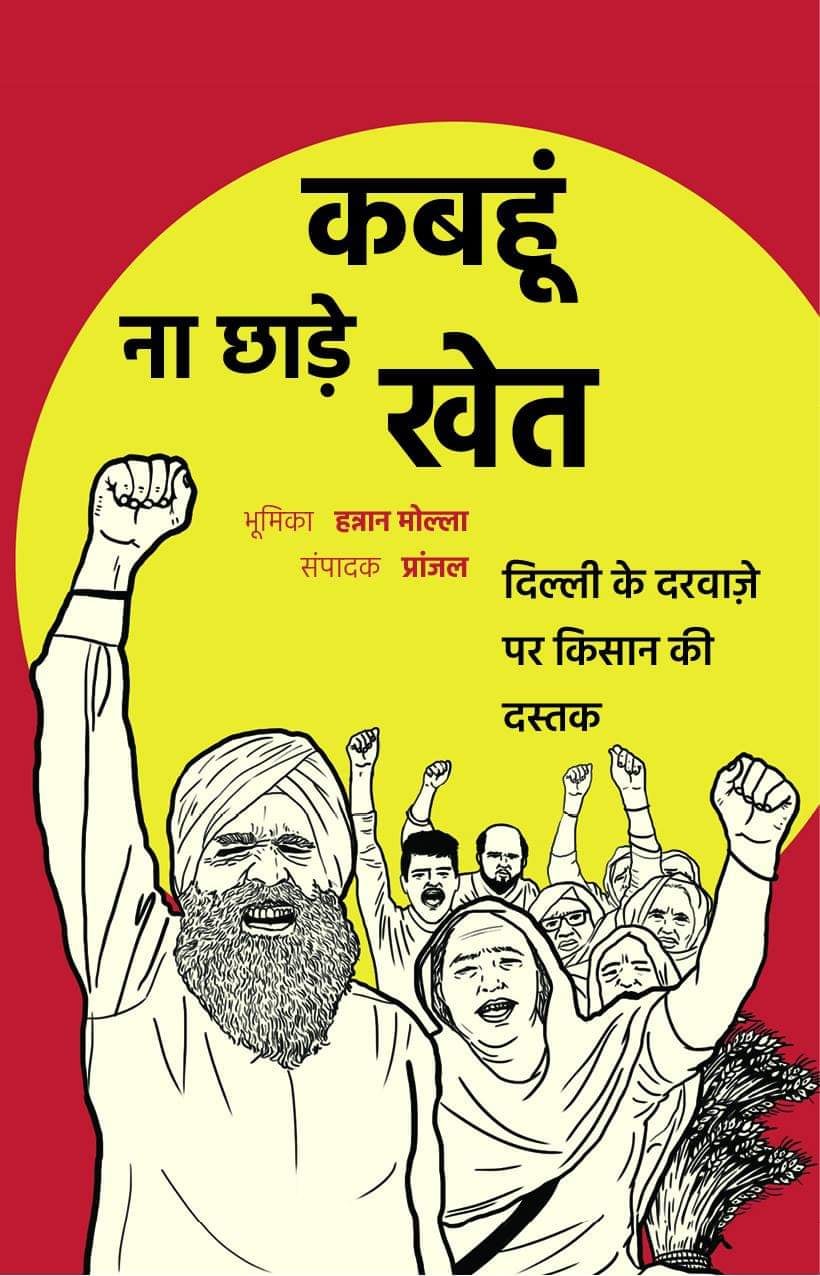
very happy to announce publication of a compilation of essays Kabhun Na Chade Khet related to Farmers Protest by Vaam, the Hindi imprint from Left Word Books.

The book has a foreword by farmer leader Hannan Mollah, is edited by Pranjal, includes essays by many including me.
The book is priced at Rs 90 and is available from here.

Please buy, spread, especially at Ghazipur, Palwal, Shajahanpur, Chilla and urban Hindi speaking India.